
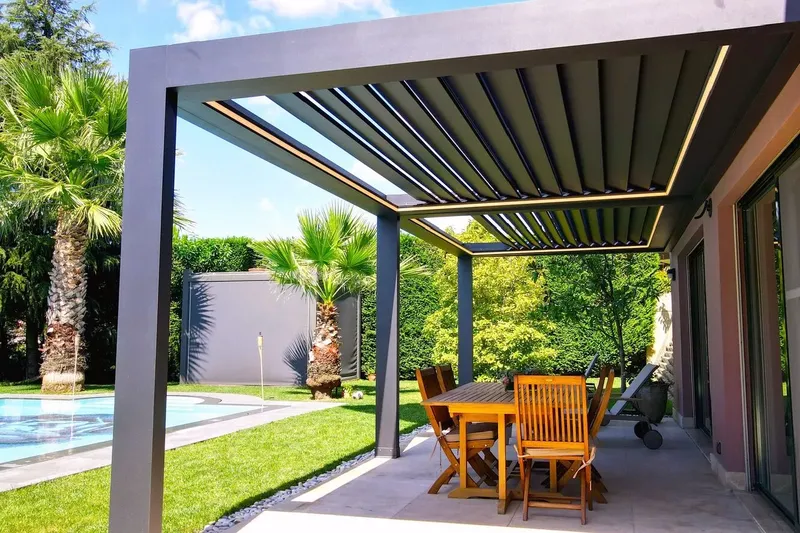
How motorised louvre roofs work, what a rain sensor actually does, remote and smart-home control, and whether motorisation is worth it for your Illawarra home.
If you have started looking at louvre roofs for your Illawarra home, you have probably noticed most people end up choosing a motorised system over a manual one. This guide explains exactly what motorisation gets you, how rain sensors work, what a quality motor like Somfy adds, and how to decide whether the extra cost is worth it for your situation. It is written for real Wollongong, Shellharbour and Kiama conditions, not a generic sales pitch.
First, the basics. A louvre roof, also called an opening roof, uses aluminium blades on a rotating spindle. On a manual system you turn a crank handle or pole to angle the blades open or closed. On a motorised system, a motor does that work for you at the press of a button, from a remote, a wall switch, or an app. The blades still do the same job, breeze and filtered light when open, a sealed weatherproof roof when closed, but you control them without lifting a finger.
The single best reason to motorise: the rain sensor. This is a small detector, usually mounted on the frame, that senses the first drops of rain and automatically closes the blades, even if nobody is home. In a region where a clear, sunny Wollongong morning can turn to a downpour off the escarpment within the hour, this is the feature people value most a year after installation. It protects your outdoor furniture, flooring and anything else under the roof without you having to rush outside or worry about it while you are at work. A manual roof simply cannot do this, if you are not there to crank it, it stays open.
How the control options work. Most motorised louvre roofs come with a handheld remote as standard, and many can be operated from a fixed wall switch as well, which is handy so a remote never goes missing. Beyond that, quality motor systems, Somfy being the best known, can integrate with smart home setups, so the roof can be grouped with other automated blinds and controls, operated from a phone app, or triggered on a schedule. If you already run smart lighting or automated blinds, your louvre roof can usually join the same ecosystem. If you do not, a simple remote and wall switch is perfectly sufficient.
Why motor quality matters, especially near the coast. The motor is doing repeated work, opening and closing a large, heavy set of aluminium blades, often on an exposed site facing salt air and wind. A cheap motor is exactly the wrong place to save money, because if it fails you have lost the main advantage of the roof. This is why we specify quality motors such as Somfy and pair them with corrosion-resistant components rated for Illawarra's coastal conditions. It is the difference between a system that quietly works for years and one that becomes a source of callbacks.
What motorisation adds to the cost. As a rough guide, motorisation, including the motor, wiring and controls, typically adds a few thousand dollars over an equivalent manual roof, and a rain sensor is a modest extra on top. For most homeowners that is money well spent, given the convenience and the furniture protection the sensor provides. If your budget is tight right now, it is worth knowing that some systems can be built to accept motorisation later, so you can start manual and upgrade down the track, though it is usually cheaper to motorise from the start if you know you will want it. Our louvre roof cost guide breaks the pricing down in more detail.
Add-ons that pair well with a motorised roof. Because you already have power running to the structure, a motorised louvre roof is a natural base for integrated LED lighting, ceiling fans for humid coastal evenings, outdoor heating strips for winter, and motorised side screens or zip screens to close the space in against wind and rain. Planning these in from the start is cheaper than retrofitting, so it is worth thinking about how you will use the space year-round before you finalise the design.
So, is motorisation worth it? For the large majority of Illawarra homeowners, yes, mainly for the rain sensor and the everyday convenience on larger or higher roofs that are awkward to crank by hand. Manual systems still make sense for smaller, budget-conscious projects or covered areas you rarely need to adjust. The honest answer depends on your roof size, how you use the space, and your budget, which is exactly what a free on-site measure and quote is for.
A few common questions. Does the rain sensor work when I am not home? Yes, that is the whole point, it detects rain and closes the blades automatically regardless of whether anyone is there. What happens in a power outage? Quality motorised systems include a manual override so you can still operate the roof if power is lost, which is worth confirming is included in your quote. Can I control it from my phone? With a smart-home-capable motor such as Somfy, yes, the roof can be app-controlled and integrated with other automation, though a standard remote and wall switch suit plenty of homes just fine. Is a motor reliable in salt air? A quality motor paired with corrosion-resistant, coastal-grade components is built for it, which is exactly why component choice matters more than saving a few dollars on a cheap motor. Ready to talk specifics? Book a free on-site measure and quote and we will walk you through manual versus motorised for your exact space.