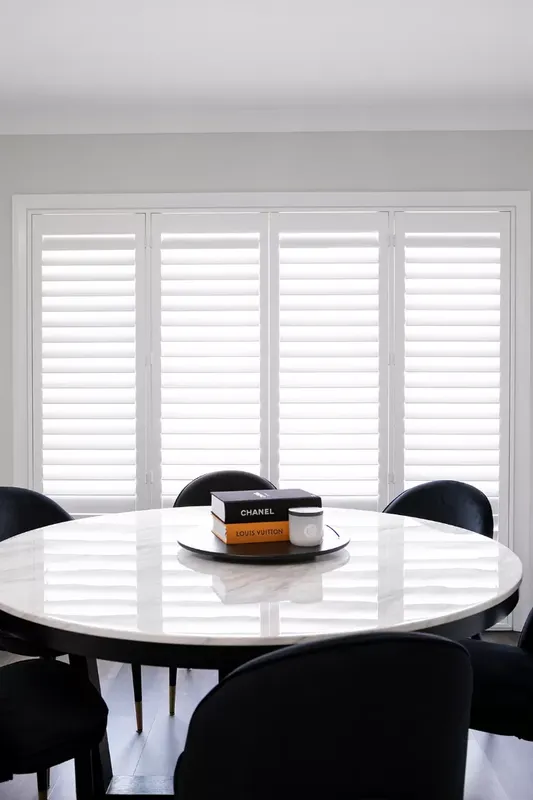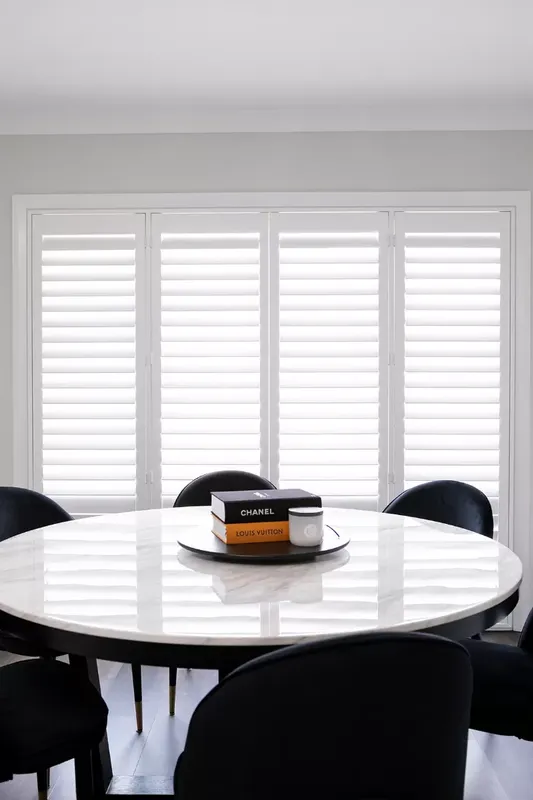
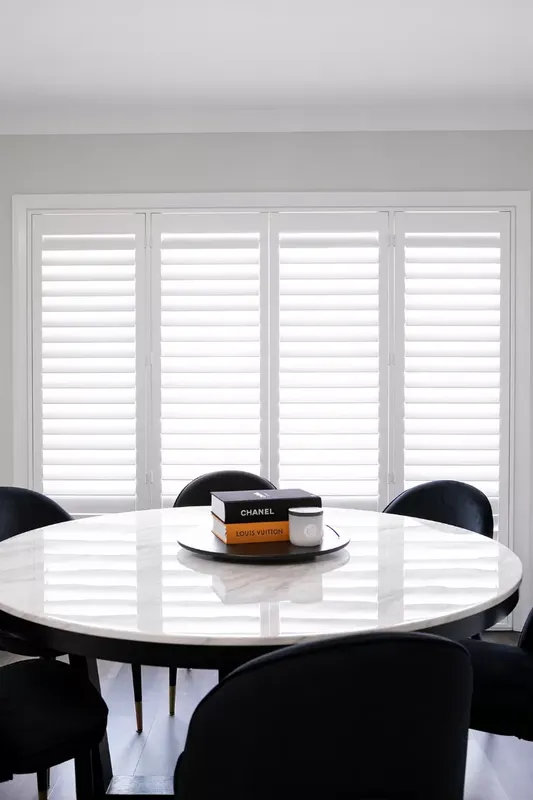
Explore the various types of plantation shutters available and discover which one is right for your home.
“Plantation shutters” describes a family of window coverings rather than one identical product. The louvre size, frame, panel arrangement, material, tilt control and opening style can all change the way a shutter looks and performs. Understanding the main types makes it easier to compare a quotation and choose a covering that suits the room, the window and the way the household uses it.
1. Full-height plantation shutters
Full-height shutters cover the window from sill to head in one continuous arrangement. They give a clean, architectural appearance and provide consistent privacy and light control across the opening. A divider rail can split the upper and lower louvres so the top can remain open while the lower section stays closed. This is useful for street-facing rooms, bedrooms and homes where privacy changes during the day.
Full-height panels work especially well on standard windows and tall openings with enough room for the panels to stack or open. The measure should check the handle position, the sill depth and whether furniture will prevent the panels from opening fully.
2. Café-style shutters
Café-style shutters cover only part of the window, usually the lower section. They preserve daylight and an outward view above the shutter while screening the part of the window most exposed to passers-by. They can suit a front room, a kitchen window or a low sill where complete coverage is not essential.
The limitation is equally important: the uncovered upper glass still admits sun and does not provide full privacy after dark. Café style is a deliberate balance between outlook and screening, not a cheaper version of a full-height shutter.
3. Tier-on-tier shutters
Tier-on-tier shutters use independently opening upper and lower panels. They give more flexibility than a single full-height panel because the household can open the top for light and keep the bottom closed for privacy. They are useful on tall windows, particularly in rooms where the view and privacy need to be managed separately.
Because there are more panels and hinges, tier-on-tier shutters need accurate alignment and adequate clearance. A good design should show which sections open first and where the panels will sit when fully opened.
4. Solid-panel shutters
Solid-panel shutters use one or more flat panels without adjustable louvres. They can echo traditional joinery in a period home and provide a strong privacy and blackout effect when closed. They are often used as a feature on a selected window, a narrow opening or a room where the visual simplicity of a solid panel is more important than adjustable ventilation.
Solid panels do not offer the same fine control of breeze and daylight as louvred shutters. They also need a sensible place to open, so the surrounding furniture and wall space should be checked at the measure.
5. Café-door shutters
Café-door shutters are hinged like a door and can be used across an opening or as a half-height divider. They are a practical choice for a doorway, a servery or an internal opening where the shutter needs to swing rather than slide. The panel height, hinge direction and handle position should be planned around how people move through the room.
They are not a substitute for a lockable external door or a child-safety barrier unless the specific system has been designed and approved for that purpose. Their value is flexible separation, privacy and light control in the right interior opening.
6. Sliding-track shutters
Sliding shutters travel across a track rather than swinging into the room. They are useful for wide windows, stackable doors and openings where furniture or a narrow reveal leaves little room for hinged panels. The track can allow the shutters to cover a broad span while keeping the floor area clear.
Track planning is critical. The installer should check the top fixing, floor level, stacking direction and any curtains, handles or architraves that could interfere with the panels. A sliding system changes how the opening is used, so the preferred stack position should be agreed before manufacture.
7. Bi-fold shutters
Bi-fold shutters use hinged panels that fold together as they open. They can cover a wide opening while creating a compact stack at the side, and they suit selected bi-fold doors, wide windows and room dividers. The number of panels and the direction of the fold determine how much access remains when the shutters are open.
Large bi-fold arrangements place more importance on hinge quality, panel weight and alignment. A split that looks symmetrical on a plan may not be the most useful split in the room if it places a handle or stack in the main walking path.
8. Shaped and specialty shutters
Arched, angled, circular and unusually shaped windows can often be covered with a made-to-measure shutter. In these situations, the shape of the opening is part of the design rather than a small variation on a standard rectangle. Some shaped shutters have fixed louvres or a limited operating area, because the geometry does not allow every blade to tilt through the same range.
Measure the window in detail and confirm which sections will open, how the shutter will be cleaned and where the frame will sit. A shaped shutter can be a strong architectural feature when its operating limits are understood from the start.
9. Outdoor and aluminium shutters
Outdoor or aluminium shutters are designed for more demanding exposure than ordinary internal timber shutters. They can provide screening and ventilation on a balcony, alfresco or semi-outdoor area, subject to the system's wind and weather guidance. The finish, fasteners, drainage and frame fixing all matter, especially near the coast.
Aluminium shutters have a crisp, stable appearance and are easier to specify for some exposed openings, but they are not automatically suitable for every outdoor situation. Ask about the actual wind rating, cleaning routine and safe operating position. A coastal home may need more frequent salt removal than a sheltered inland home.
Choosing the louvre size
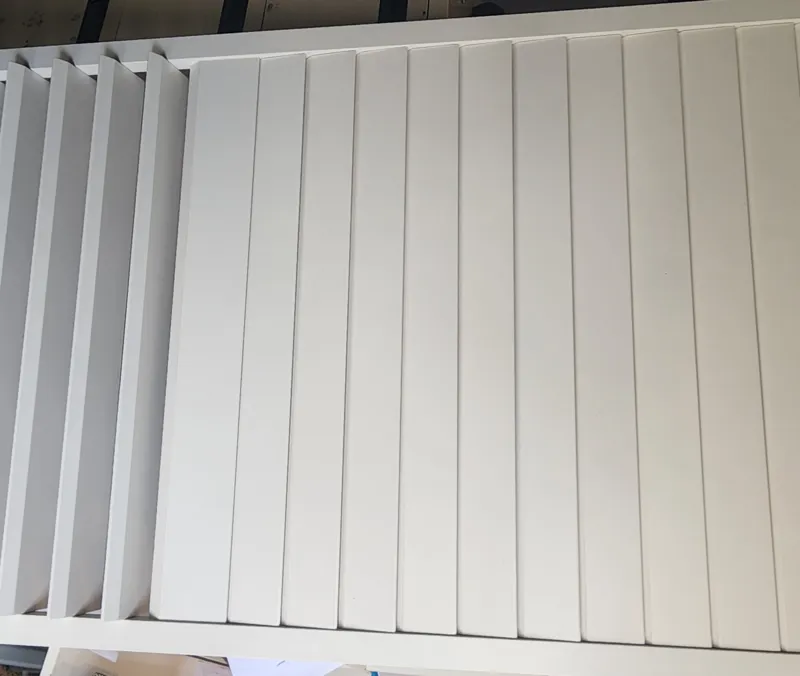
Louvre size changes both the appearance and the amount of view available when the blades are open. Wider louvres create a calmer, more contemporary look and fewer horizontal lines. Smaller louvres can suit a traditional room or a narrow opening and may give more adjustment points. The right size depends on the window proportions, the preferred style and the level of privacy needed.
Do not judge a louvre from a small sample alone. Look at a full panel or an installed example if possible. The frame colour, divider rail and handle style can change the overall impression as much as the blade width.
Choosing the material
Basswood is light and refined for dry internal rooms and large internal spans. PVC or polymer is more forgiving in bathrooms, laundries and kitchens where moisture and cleaning are part of everyday use. Aluminium can be appropriate for selected coastal, balcony or semi-outdoor openings. The material should follow the room conditions, panel size and exposure rather than being selected only by appearance.
Weight, moisture tolerance and maintenance are practical differences. A heavy panel can be tiring on a frequently used door, while timber needs protection from persistent condensation and splash. Polymer is not immune to poor installation, and aluminium still needs suitable hardware and finish. A clear quotation should explain the construction and the limitations.
Getting the installation right
Plantation shutters are made to the opening, so accurate measuring is essential. Check the reveal depth, sill, head, architraves, window handles, skirting boards and nearby furniture. Decide whether panels will open into the room, fold, slide or stack. Confirm how the frame will be fixed and how any uneven wall or floor will be handled.
After installation, test every panel through its full movement and check that louvres tilt evenly without rubbing. Ask how to clean the finish, where not to use water and how to adjust or report a hinge issue. Good maintenance is simple when the shutter has been specified for the room and fitted square.
Which type suits an Illawarra home?
For a dry living room, full-height basswood shutters may provide the best combination of warmth, control and easy operation. A tall street-facing window may benefit from tier-on-tier panels. A bathroom or kitchen is usually better served by a moisture-tolerant polymer construction. A broad balcony opening may call for a sliding or aluminium system after wind and fixing conditions are assessed.
There is no single “best” plantation shutter type. The best result balances privacy, daylight, ventilation, panel movement, material behaviour and the character of the home. Compare the operating design as carefully as the colour, and ask the installer to explain what the shutter will do when it is open, closed and being cleaned. That makes the decision practical long after the sample has been put away.