
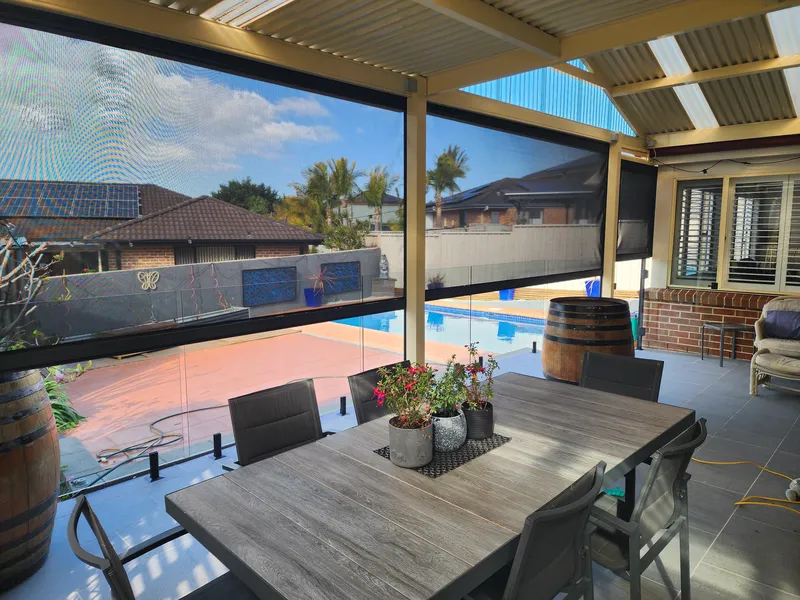
Essential guide to wind-rated outdoor blinds for Wollongong's coastal conditions. Wind load ratings, fabric choices, and installation requirements for balconies.
Wind-rated outdoor blinds for Wollongong balconies must withstand 85-120km/h winds depending on building height and exposure. Class 3 wind ratings (85km/h) suit most residential applications, while Class 4 (100km/h) required for high-rise and exposed coastal locations. Proper installation includes structural anchoring, wind sensors, and automatic retraction systems costing $1,500-3,500 per blind.
Wollongong's coastal location and elevated terrain create challenging wind conditions requiring specialized outdoor blind systems designed for high wind loads and automatic weather protection. Understanding wind ratings ensures safe and reliable operation while protecting your investment from weather damage. Australian Standard AS 4084 defines wind classifications with Class 3 (85km/h) suitable for most residential balconies up to 3 stories, Class 4 (100km/h) for high-rise buildings and exposed coastal locations, and Class 5 (120km/h) for extreme exposure including beachfront towers. Professional wind assessment considers building height, surrounding structures, topography, and proximity to the ocean to determine appropriate ratings. Fabric selection impacts wind performance: perforated mesh allows wind passage reducing load (recommended for high-wind locations), solid blockout fabrics create higher wind loads requiring stronger mounting systems, while hybrid fabrics balance wind resistance with privacy and weather protection. Track-guided zip screen systems provide superior wind performance through complete edge sealing, eliminating fabric flapping and reducing wind loads compared to traditional drop blinds. The sealed zipper system maintains structural integrity even in gusty conditions common along Wollongong's coastal areas. Mounting systems for wind-rated installations require structural assessment and often reinforcement. Standard masonry anchors insufficient for high wind loads, requiring chemical anchors, through-bolts to structural elements, or additional framework to distribute loads. Professional installation includes wind load calculations, mounting point inspection, and certification for insurance and compliance purposes. Automatic wind sensors provide essential protection by monitoring wind speed and automatically retracting blinds when safe limits are exceeded. These systems typically activate at 50-60km/h, providing safety margin before reaching blind rating limits. Integration with home automation allows manual override and remote monitoring during severe weather events. Balcony-specific considerations include edge mounting requirements (top-fix, side-mount, or bracket mounting), drainage for weather protection, and clearance for opening doors and windows. Corner installations require specialized hardware and often custom fabrication to maintain wind ratings while providing complete coverage.