
Awnings in Kiama
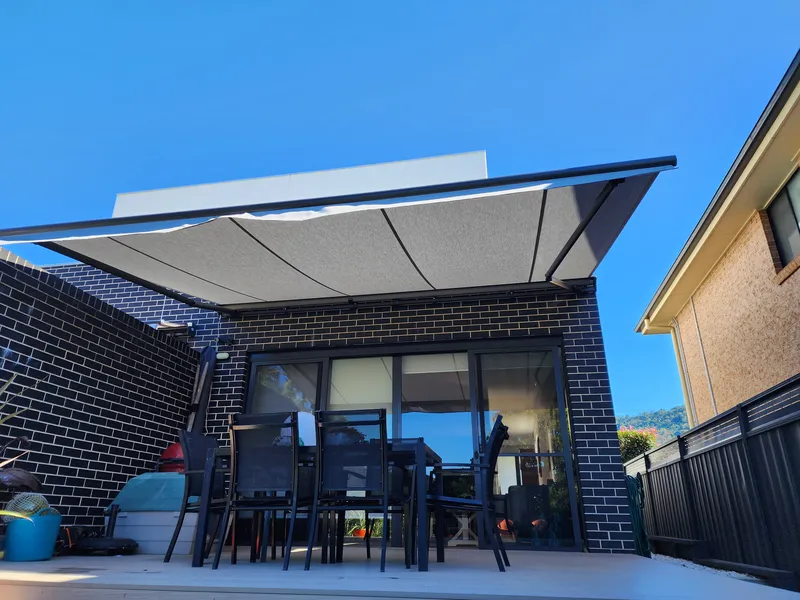
Awnings in Kiama should be selected from the wind outward. Homes at Kiama Heights, Bombo, Gerringong and above Werri Beach can receive a southerly buster with very little warning, while a cottage near Terralong Street has a completely different streetscape and proportion. Jamberoo is the useful contrast: rain shelter and damp valley conditions can matter more than maximum wind exposure. We match the awning form, fixing method, retraction control and appearance to the opening instead of fitting the same folding arm everywhere.
Wind rating comes before colour
A folding arm that is acceptable in a sheltered courtyard can be under-rated on an exposed Kiama headland. A southerly buster can arrive hard and fast, putting force through the extended fabric, arms and wall brackets before someone has time to retract it. The chosen system must have wind guidance appropriate to the site, and the structure behind the brackets must be checked. Colour, valance and projection are design decisions after the exposure and safe operating position have been established.
Automatic retract on exposed positions
Automatic retraction from a wind sensor is a strong practical choice for Kiama Heights, Bombo, Gerroa and the Werri escarpment. It protects the awning when the house is empty and responds to a change that may be missed during an evening outside. A sensor does not make an awning storm-proof: the system still needs to be used within its instructions, and severe weather may require it to remain fully retracted. We explain the manual override and the circumstances in which the owner should take control.
The heritage question in central Kiama
Terralong Street and the Collins Street cottages have window proportions and streetscapes that deserve a quieter awning treatment. A modern folding arm with prominent hardware can look unrelated to a tall original window or a heritage façade. A traditional fixed canopy or a straight-drop style can provide shade while following the simpler lines of the cottage. Before changing a visible façade in a heritage conservation area, confirm the relevant planning requirements and choose a design that respects the original opening rather than hiding it.
Jamberoo's different priority
Jamberoo, Foxground and Rose Valley are cooler, damper and more sheltered than the exposed coast. Here the useful question may be how to keep rain off a doorway or outdoor table while allowing the valley air to move through. A straight-drop or carefully placed fixed canopy can be more practical than a large folding arm selected for headland wind. The older weatherboard farmhouse setting also calls for fixing details that sit comfortably with the existing roofline and timber work.
Projection for ocean outlooks
A good awning should reduce glare and heat without turning a prized outlook into a dark strip. At a Gerringong, Gerroa or Kiama Heights home, we assess when the sun reaches the glass and whether the awning will shade a room, a deck or both. Projection, height and fabric openness work together. A lighter open-weave fabric may preserve the view and breeze, while a denser option gives stronger shade. The result is tested against the way the outdoor area is actually occupied.
A local measure that separates the zones
The consultation records the wind exposure, orientation, fixing surface, heritage context and the people-moving route below the awning. We then compare a folding arm, traditional fixed canopy or straight-drop arrangement and explain the operating limits. The final measure confirms bracket positions, clearances and any sensor or motor requirements. Installation includes checking the fall, arm movement, retraction and fabric alignment. For Kiama's coast and valley alike, careful setup is more important than a generic promise that an awning will suit every weather condition.
What happens after fitting
Owners receive practical guidance for everyday operation, including when the system should be retracted, how to respond to a sensor alert and how to keep salt or valley moisture from accumulating. Fabric should be cleaned according to its care instructions rather than scrubbed aggressively. Brackets, arms and fixings deserve occasional visual checks, particularly after a strong weather event. These simple habits protect the investment without pretending that any awning can be left extended in every condition.
Choose the awning for its weather job
A Kiama awning should have one clear job: shade a western room, protect a cottage entry, provide rain cover at a Jamberoo table or make a deck more usable between weather changes. Naming that job makes it easier to select the right form and projection. It also prevents a decorative choice from being expected to perform like a headland-rated weather system.
Related advice for Kiama homes
Continue planning your awnings with these related guides:
Want to explore the full range? View our complete Awnings range →
Frequently Asked Questions — Awnings in Kiama
Check the site's wind exposure, the structural fixing surface, the awning's wind guidance, the projection and the safe retraction method. An automatic wind sensor is worth discussing for an exposed position, but it does not replace correct use in severe weather.
A prominent modern arm can conflict with the tall original window proportions and a heritage streetscape. A traditional fixed canopy or straight-drop style may provide shade with a quieter relationship to the cottage, subject to any applicable conservation controls.
It can be suitable where rain shelter and a simple connection to the existing building matter more than maximum coastal wind performance. The opening, fixing points and the way the blind will be operated still need an on-site assessment.
A wind sensor can automatically retract a compatible awning when its set conditions are reached, which is useful when a home is unattended. The system must still be selected and operated within its manufacturer's limits.
Set the projection and height against the actual sun path, then compare fabric openness for glare control, airflow and view. A site measure is the reliable way to balance shade with the outlook from the rooms and deck.
Other Popular Products in Kiama
Plantation Shutters
Learn more about our plantation shutters options for Kiama homes
Roller Blinds
Learn more about our roller blinds options for Kiama homes
Venetian Blinds
Learn more about our venetian blinds options for Kiama homes
Zip Screens
Learn more about our zip screens options for Kiama homes
Roller Shutters
Learn more about our roller shutters options for Kiama homes
Awnings
Learn more about our awnings options for Kiama homes
Zip Screens
Learn more about our zip screens options for Kiama homes
Ready to Transform Your Windows?
Contact us today for a free consultation and quote on your custom window furnishing project.
Call Darren: 0411 397 100